A corner sofa is built from the same parts as any upholstered sofa (frame, suspension, foam, fabric) but adds three things a straight sofa does not have: a corner seat, a joint between sections and a fixed or reversible orientation. When you buy corner sofas from a manufacturer, those three points are where specifications differ most and where you should write the details into the purchase order.
This guide is written by ellda mobilya, a furniture manufacturer in Kayseri, Türkiye, producing sofa sets, corner sofas, bed base sets and mattresses since 2010. Corner sofas are one of our four product groups, so the specification points below are the ones we go through with retailers and importers before a corner model goes into production for them.
The parts of a corner sofa
A corner sofa (also called an L-shaped or sectional sofa) is a seat made of two or more sections that meet at an angle. A useful way to read any manufacturer's offer is to split it into parts:
- Frame: the structure of each section, including the base rails that carry the seat and the joints that hold arms and backs.
- Suspension: what sits between the frame and the seat foam, such as sprung or webbed support.
- Seat and back filling: the foam or fibre layers in seats, backs and arms, and whether cushions are fixed or loose.
- Section connectors: the hardware that holds sections together at the corner.
- Mechanisms: optional moving parts, such as a sofa-bed conversion, adjustable headrests or a storage compartment.
- Cover: the fabric, how it is cut and sewn, and whether it is removable.
- Legs and finishing: leg material, height and how legs are fixed and packed.
The rest of this guide goes through the parts that are specific to corner sofas. For the general questions to ask any sofa factory, from foam to quote terms, see our sofa manufacturer question list.
Frame and the corner seat
The corner seat is the weakest point in many sectionals. It spans a larger square than a normal seat, it is sat on from two directions, and it has no arm to brace it. Ask the manufacturer how the corner section is built: whether it is a separate section or part of one long side, how the base under the corner is supported, and whether the frame differs from that of the straight sections.
Write down the frame material for each section. It matters for durability, and it can matter for customs: upholstered seats fall under HS heading 9401, with subheadings that depend on frame material and whether the seat converts into a bed (WCO nomenclature). A corner sofa with a bed mechanism may be classified differently from the same model without one, so confirm the HS code with your customs broker for each version you order.
Seat depth, foam and comfort across the corner
Corner sofas are bought for lounging, and buyers often compare models by seat depth. The overall depth is what appears in the catalogue; the usable seat depth is shorter, after the back cushions. Ask for both.
Ask for the foam type and density, or a written specification, for each part: seat, back, arm and corner. A corner seat that uses a softer or thinner block than the rest will sag first. If your market has flammability rules for fillings, raise them here too (see the compliance section below). Specifications for frame, foam and fabric vary between factories and between models from the same factory, so get them per model, in writing.
Section connectors and modular layouts
A corner sofa travels as separate sections and is joined at the destination. The connector decides how stable the finished sofa is and how easy it is for your delivery team to assemble.
Ask:
- How many sections the model has and how they connect (brackets, bolts or hooks).
- Whether connectors are fitted at the factory or packed separately, and in which package.
- Whether the sections stay aligned on a smooth floor, or need anti-slip feet.
- For modular models, which modules can be swapped or added, so you can offer different lengths from one range.
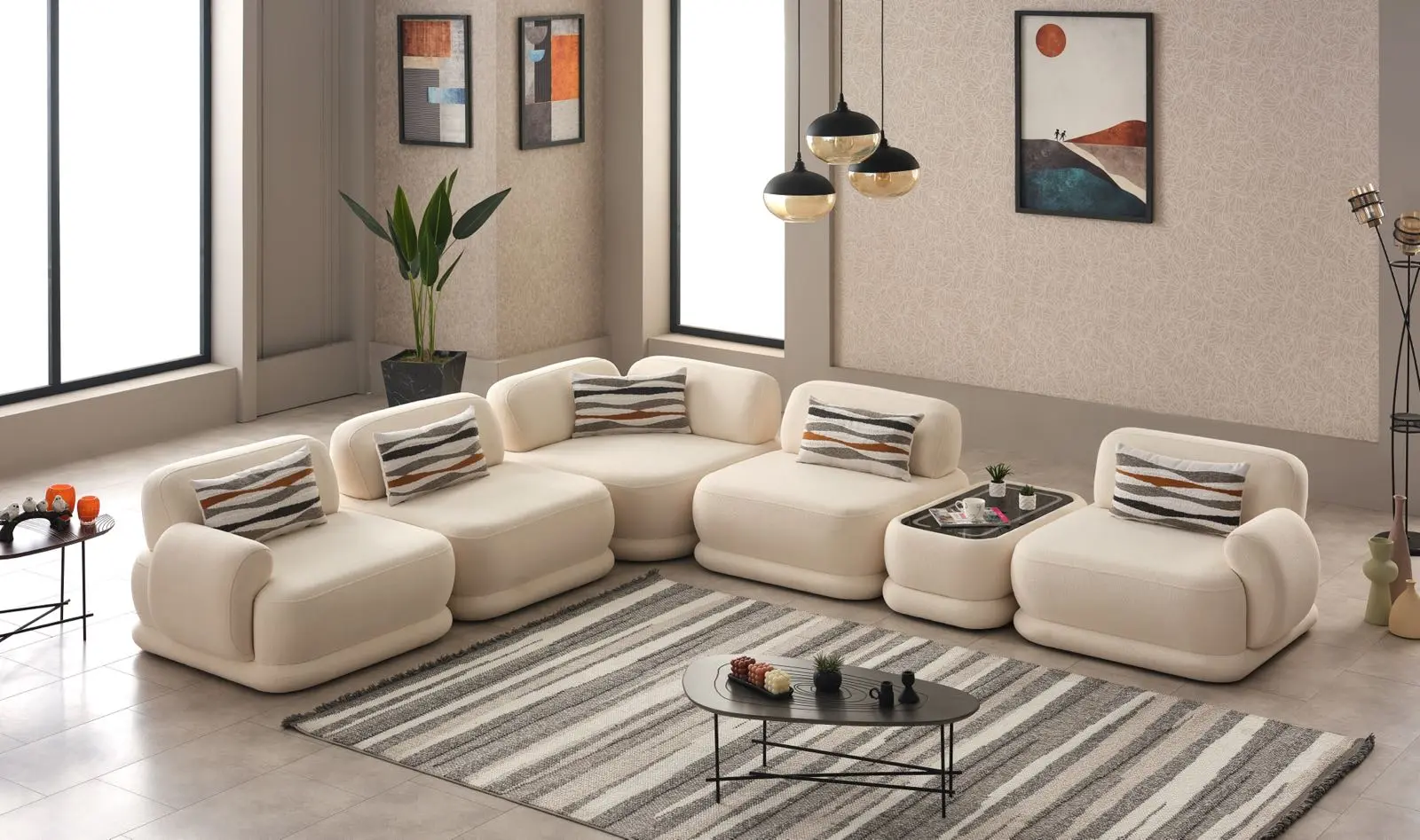
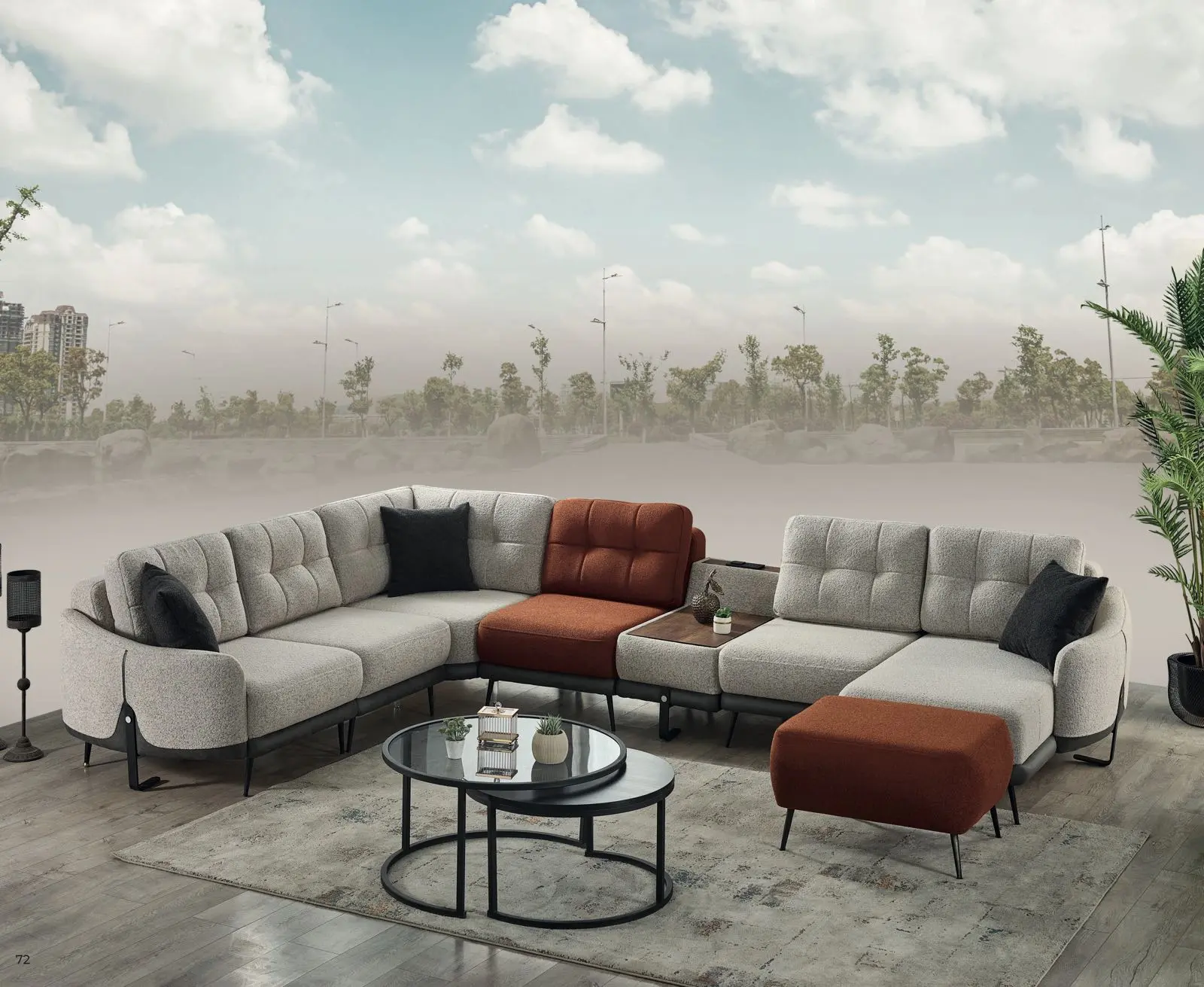
Modular corner sofas with table, shelf or pouf modules are common in Turkish ranges. In our catalogue, Santos has a modular build with a glass-top table module, Asel adds a wooden table module and a pouf, and Gemlik has a side unit with wooden shelves. Each extra module is another package and another joint, so list them separately in the order.
Left hand, right hand and reversible chaises
Every L-shaped sofa has an orientation. Manufacturers do not all name it the same way: "left" may mean the long side is on your left as you face the sofa, or as you sit on it. Agree the definition in writing, ideally with a sketch on the order, and state the quantity per orientation.
Some models are reversible, with a chaise or short side that can be moved to either end. Most fixed-frame corner sofas are not. For a retailer, the split between left and right is a stock decision: a showroom usually needs both, and the wrong ratio leaves stock that fits only half the customers' rooms.
Mechanisms in corner sofas
Mechanisms add function and add points to check. The common ones in corner sofas are:
- Sofa-bed conversion, usually in the long side, sometimes with a storage box. Ask for the sleeping surface dimensions and how the mechanism is tested before packing. Our Polo corner sofa is shown with a bed mechanism.
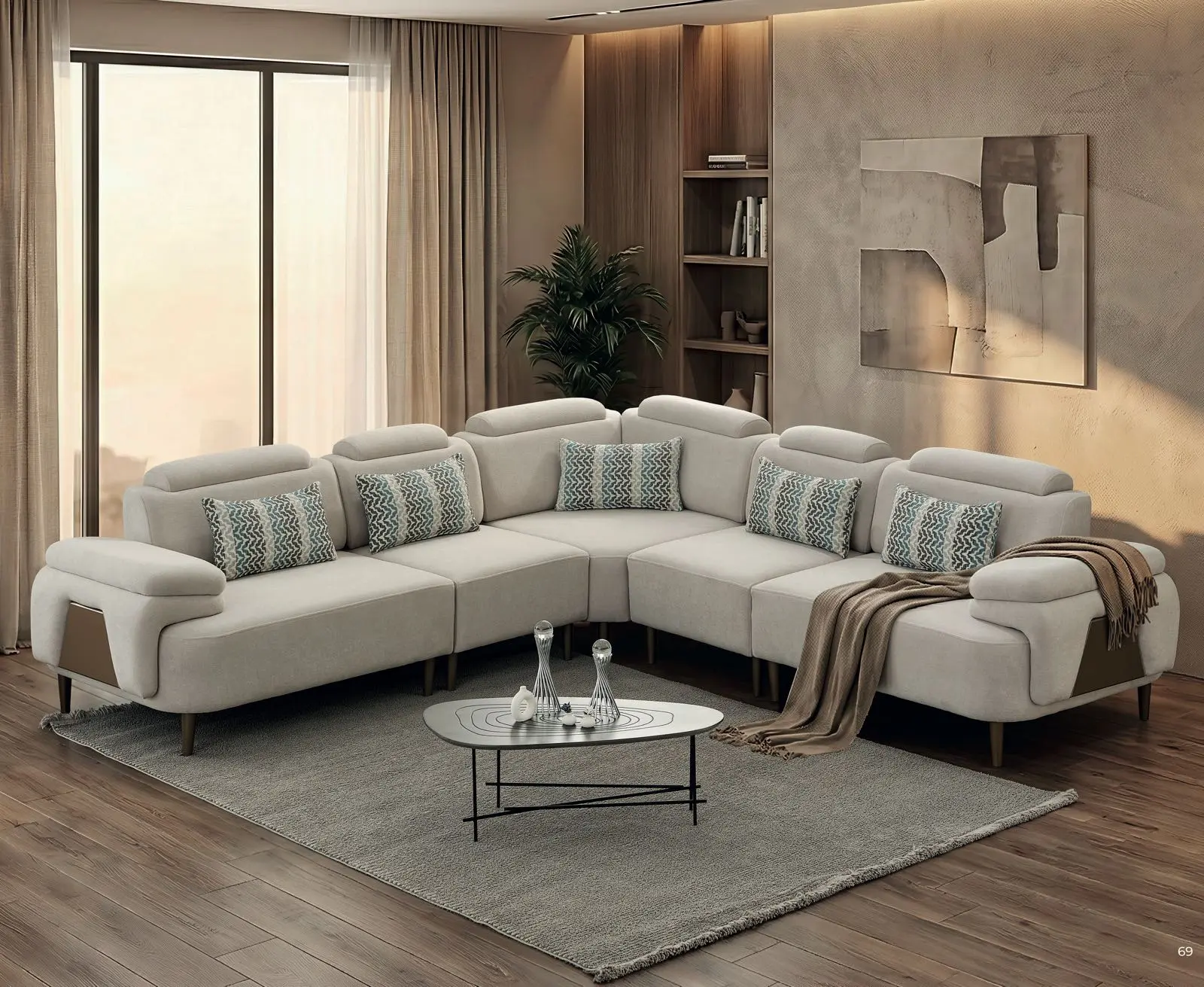
- Adjustable headrests, which let a low-back design support the head. Ask how many positions they have and how they are fixed. The Zirve model has adjustable headrests.
- Storage compartments under a seat or chaise.
Ask how spare parts are supplied for each mechanism, since a failed mechanism in a corner sofa often means replacing a whole section.
Fabric and the cover
The fabric is what your customer sees and touches first. For corner sofas, also ask whether the cover pattern runs continuously across sections and whether the corner seat cushion is cut to match.
Ask for the available fabric groups per model, how colour is confirmed before production (swatch or approved sample) and what test data exists for abrasion (the Martindale rub test is common in Europe) and colour fastness. Bouclé, velvet and textured weaves are frequent on corner sofas; they behave differently in wear and cleaning, so match the fabric to the end use, such as family living rooms or projects.
Compliance: flammability and labels
Rules for upholstered furniture differ by market, and they apply to the whole sofa, not only to the fabric.
- United Kingdom: the Furniture and Furnishings (Fire) (Safety) Regulations 1988 apply to domestic upholstered furniture, covering fillings, covers and labelling.
- United States: 16 CFR Part 1640 sets the federal flammability standard for upholstered furniture, with a permanent label.
- Other markets have their own requirements; check them with your importer or testing body.
State your market in the first enquiry. The manufacturer should confirm in the quote what it can provide for each model and fabric for that market, not answer "yes, everything is compliant".
Specification sheet for a corner sofa order
Use this as the minimum written specification per corner model:
| Item | What to write down |
|---|---|
| Model and orientation | Model name, left or right (with your definition), quantity per orientation |
| Dimensions | Long side, short side, overall depth, seat depth, seat and overall height |
| Sections | Number of sections, connector type, packages per sofa |
| Frame | Material per section, how the corner section is supported |
| Suspension and foam | Type and density for seat, back, arm and corner |
| Mechanisms | Type, position, how tested, spare parts |
| Cover | Fabric group, colour reference, approved swatch, removable or fixed |
| Legs | Material, height, packed separately or fitted |
| Compliance | Target market and what the factory confirms for it |
| Packing | Method per section, labels, loading plan |
Our corner sofa range at a glance
All ten corner sofas in our 2026 catalogue are L-shaped. Dimensions are as printed in the catalogue (cm); small batch differences are possible.
| Model | Long side | Short side | Depth | Height |
|---|---|---|---|---|
| Zirve | 310 | 310 | 100 | 85 |
| Petra | 300 | 300 | 105 | 78 |
| Asel | 375 | 255 | 94 | 72 |
| Santos | 355 | 300 | 92 | 68 |
| Ahlat | 305 | 240 | 100 | 73 |
| Polo | 305 | 305 | 85 | 80 |
| Gemlik | 305 | 263 | 98 | not printed |
| Mila | 305 | 268 | 100 | 73 |
| Begonya | 320 | 255 | 90 | 67 |
| Oslo | 270 | 200 | 100 | 85 |
Long sides run from 270 cm (Oslo, with a chaise form) to 375 cm (Asel), so the range covers both compact living rooms and large open-plan spaces.
How ellda mobilya handles corner sofa orders
Every corner model is produced in our own 10,500 m² factory in Kayseri Organized Industrial Zone. An approved order is scheduled, then frames and pre-upholstery parts are prepared, fabric is cut, sewn and upholstered, and dimensions, stitching, surfaces and mechanisms are checked before packing. The steps are on our production page.
Frame, foam and fabric specifications, orientation, mechanisms and what we can provide for your market's rules are confirmed per model and fabric in the quote, along with price, minimum quantities and lead time. Corner sofas can share a container with sofa sets, bed base sets and mattresses, and the loading plan is shared with the quote. Dealers and buyers can see the models at the factory by appointment.
Next step
Shortlist corner models from the corner sofa catalogue, fill in the specification sheet above for each, and send it with quantities per orientation, fabric preferences and destination through our wholesale page. You can also add models to a quote list as you browse.