Export packing for furniture has one job: getting upholstered pieces, bed bases and mattresses through weeks of humidity, handling and stacking without stains, crushed corners or mould. For a sea container, that means dry goods wrapped in a sealed layer, rigid protection on every corner and edge, stacking limits written on the pack and on the loading plan, and ISPM 15 marked wood for any pallet, crate or dunnage. The importer should specify all of this in the enquiry, not discover it at the destination warehouse.
This guide is written by ellda mobilya, a furniture manufacturer in Kayseri, Türkiye, producing sofa sets, corner sofas, bed base sets and mattresses since 2010. It covers what we look at when an order is packed for a long sea route, and what you, as the buyer, should put in writing before the quote.
What damages furniture on a long sea route?
Most transit damage to upholstered furniture comes from three causes, and each needs a different defence.
- Humidity. Moisture condenses inside the container and drips onto the load or soaks into fabric, foam and packaging. The result is water marks, mould smell and softened cartons.
- Corners and edges. Packages are moved by forklift, pushed along the container floor and handled again at the destination. Corners, arm fronts, headboard edges and legs take the knocks.
- Stacking. Upholstered packages are compressible. A heavy or rigid package on top of a soft one dents seats, creases fabric and can crack a frame.
Good export packing is not one thick layer of cardboard. It is a set of layers, each aimed at one of these causes, plus a loading plan that puts every package where it can carry what is above it.
Humidity and container rain: why sealed and dry comes first
Container rain is condensation that forms on the cold steel ceiling and walls of a closed container and drips back onto the cargo. The Transport Information Service of the German insurers (TIS) explains that it is most severe under the roof, where heating by day and cooling at night keep producing water that does not dry out. Its main advice is that cargo should be loaded as dry as possible, because the cargo and its packaging are the largest sources of moisture in a closed box.
For furniture, the practical points are:
- Pack only dry goods. Foam, fabric and wooden frames hold moisture. Packing on a wet day or straight from a cold store traps that moisture under the wrap.
- Seal each piece. A film layer keeps condensation and dirt off the fabric. It works only if what is inside it was dry when it was closed.
- Keep the container floor and dunnage dry. The GDV Container Handbook lists pre-drying packaging, pallets and container flooring among its damage prevention measures.
- Consider desiccants for long or tropical routes. Desiccant bags or strips hung inside the container absorb moisture from the air. Whether they are worth adding depends on the route, the season and the transit time, so agree it with your forwarder.
- Cover the top tier. A sheet of paper or a non-woven fleece over the top layer of packages stops drips from reaching the cartons directly. The Container Handbook mentions fleece fixed below the ceiling for the same purpose.
Packing layers for sofas, bed bases and mattresses
Each product group fails in a different way, so each needs its own specification. The table shows what an importer should ask about. It is a checklist for your enquiry, not a description of a fixed ellda packing method.
| Product | Main risk | What to specify |
|---|---|---|
| Sofa sets | Stained fabric, dented seats, broken legs | Film wrap over the whole piece, rigid corner and arm protection, cardboard or board panels on exposed faces, legs removed and packed separately where the model allows |
| Corner sofas | Damage to joining faces of sections | Each section wrapped and labelled separately, connecting hardware bagged and attached to a named section |
| Bed base sets | Crushed corners, damaged lift mechanism, scratched headboard | Edge protection along the base, mechanism secured for transport, headboard packed flat as its own package with face protection |
| Mattresses | Moisture, soiled cover, deformation under load | Sealed film, flat or roll-packed as the model allows, no heavy rigid packages placed on top |
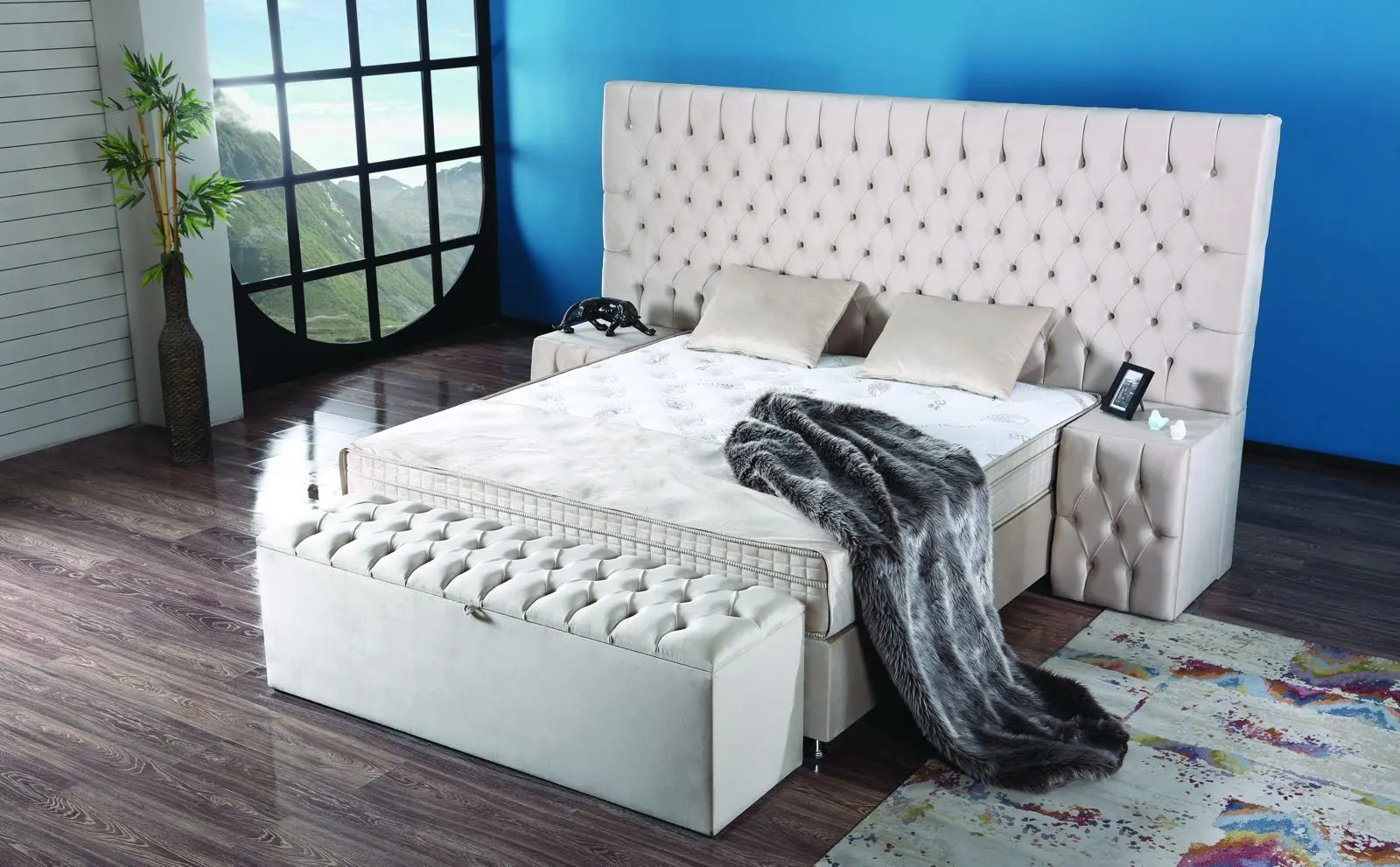
Bed base sets need extra thought because the headboard is often the largest single face in the order. The Chester bed base set, for example, has a headboard 270 cm wide. A panel that size needs protection across its whole face and a place in the loading plan where nothing presses on it. For base and storage dimensions, see our guide to storage bed base sizes.
For mattresses, ask whether a model can be roll-packed or must travel flat. Rolling saves a lot of volume, as our mixed container guide shows, but not every construction suits it.
Corners, edges and legs
Most visible damage on arrival is at a corner. When you write the packing specification, name the points that need rigid protection rather than asking for "good packing":
- Front corners and arm fronts of every sofa and armchair
- All eight corners of a bed base body
- The top and side edges of headboards
- Any exposed wooden or metal leg, which is better removed and packed in a labelled bag with its fittings
Ask also how the package will be lifted. A pack that a forklift can enter only from one side, or that two people must carry on end, should say so on the carton.
Stacking limits and the loading plan
A stacking limit is the maximum load or number of packages that can sit on top of a given package without damaging it. Upholstered furniture rarely has a printed limit from the factory, so the safe approach is to plan the load so that soft packages carry little or nothing.
A loading plan is the drawing or list that shows where each package goes in the container. For upholstered furniture and bedding, ask the plan to show:
- Heavy, rigid packages (bed base bodies) on the floor, with weight spread along the length
- Sofas on end or flat according to the packing, never under a rigid package
- Mattresses and cushion packs used as top layer or side filler, not as a base
- Gaps closed with dunnage or air bags so nothing slides on the sea leg
- Orientation marks on every carton ("this way up", "do not stack" where it applies), matching the plan
The IMO/ILO/UNECE Code of Practice for Packing of Cargo Transport Units (CTU Code) is the international reference for packing and securing cargo in containers. As of November 2026 it is a non-mandatory code of practice, but it is the document a surveyor will compare a damaged load against. How many pieces fit is a separate question, covered in our guide to sofas per 40ft container.
Wooden pallets, crates and dunnage: ISPM 15
ISPM 15 is the international standard for wood packaging material, set by the International Plant Protection Convention (IPPC). It applies to packaging made from raw wood, including pallets, crates, boxes and dunnage, and requires it to be treated against pests and marked. It does not apply to the furniture itself, only to the wood used to pack, carry or brace it.
The UK government guidance (last updated 22 April 2026) summarises the main points:
- Treatment. Heat treatment to 56°C for at least 30 continuous minutes throughout the profile of the wood, or an approved fumigation or dielectric heating method.
- Mark. Treated wood carries a mark with the two-letter ISO country code, a producer code and the treatment code.
- Exemptions. Processed wood such as plywood, and raw wood 6 mm thick or less, are outside the rules.
- Enforcement. Wood packaging that does not comply can be rejected or destroyed at import, which leaves the importer to arrange other transport for the goods.
Most importing countries enforce ISPM 15, and some add their own requirements. Last verified: 9 November 2026. Check the current rules for your destination with your customs broker or the national plant protection authority, and state in the enquiry that any solid wood pallet, crate or dunnage must carry the ISPM 15 mark.
Export packing checklist for your enquiry
Copy this into your enquiry so the packing is priced and planned from the start:
- Destination port and final destination, including any inland leg or transhipment
- Container type and whether the load is a full container or part of a mixed load
- Packing method per product group: film, corner protection, face panels, outer carton
- Legs and loose parts removed and packed with the piece, or fitted
- Mattresses flat or roll-packed, per model
- Whether you want desiccants in the container, and who supplies them
- ISPM 15 marked wood for any pallet, crate or dunnage, or no solid wood at all
- Carton labels: model, piece name, package number (for example 2/3), fabric or colour, your order number, orientation marks
- A loading plan with the quote, and photos of the loaded container before sealing
- Maximum package weight or size your warehouse can handle
The packing method also affects price and freight, so it belongs in the comparison between quotes. Our guide to furniture landed cost shows where packing sits in the total, and the guide to Incoterms for furniture importers explains at which point the risk of damage passes to you.
How ellda mobilya handles export packing
Export orders are packed for long-distance transport, and a loading plan is shared with the quote. Packing is the last stage of our production flow, after quality control of dimensions, stitching, surfaces and mechanisms, as described in our factory walkthrough.
Sofa sets, corner sofas, bed base sets and mattresses are made in the same factory in Kayseri Organized Industrial Zone and can travel in one container. Tell us the route and your packing requirements in the enquiry, and the packing method, price and shipping terms are confirmed in the quote.
Next step
Choose the models from the catalogue, add the packing points from the checklist above, and send them through our export page. We will reply with a quote and a loading plan for your order. If you are still building the list, you can collect models in a quote list.