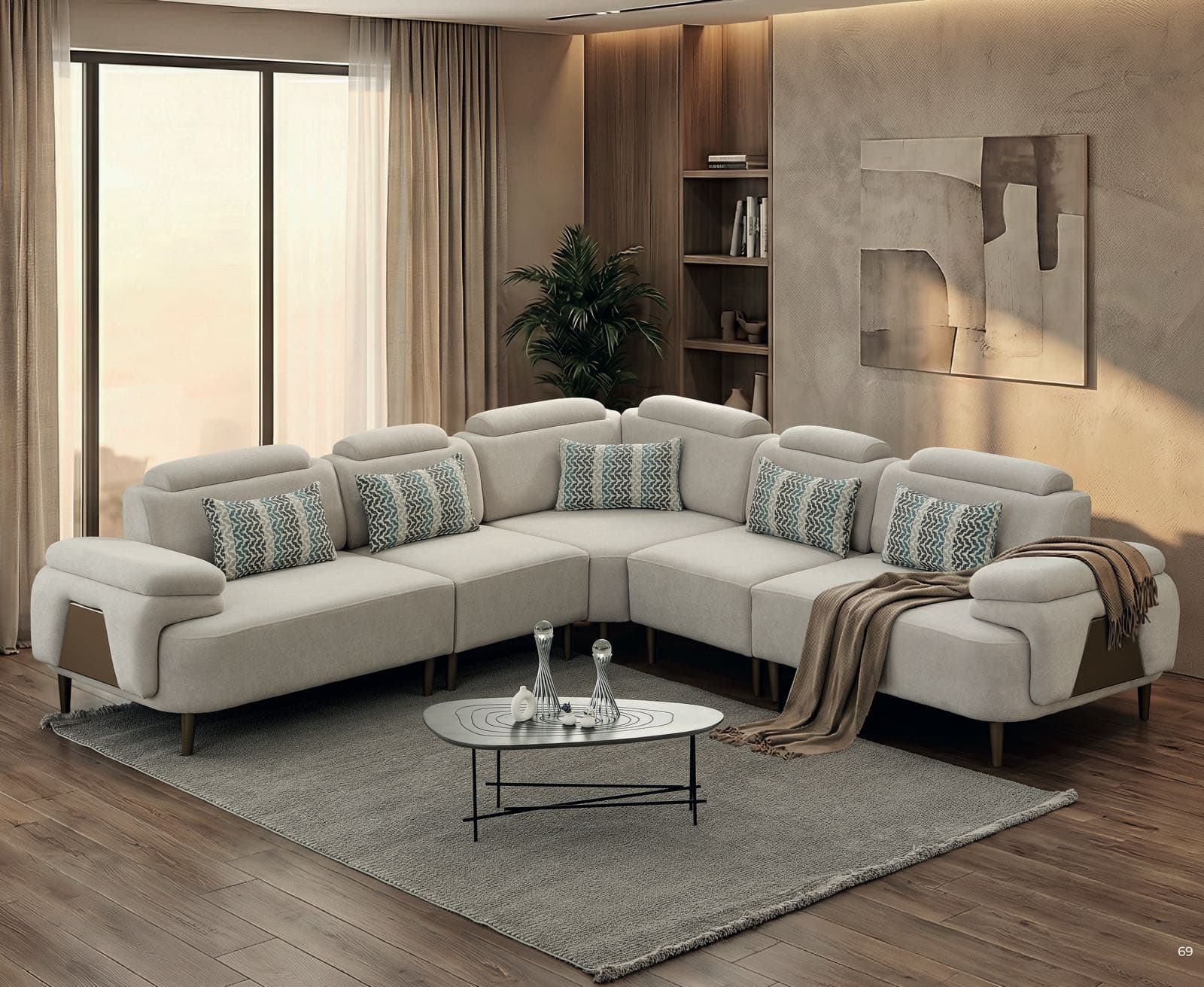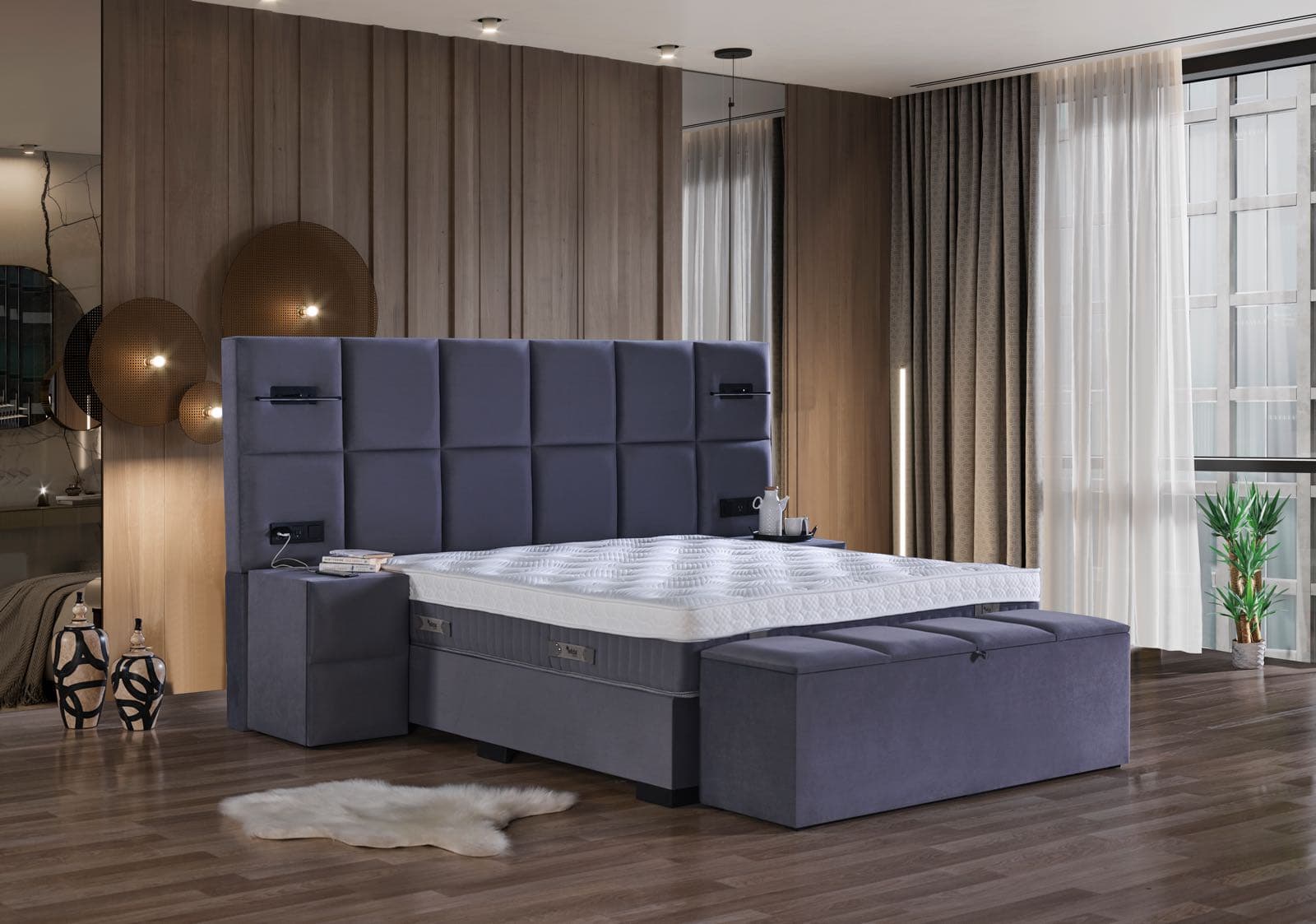
A mixed container of furniture combines several product groups, such as sofa sets, corner sofas, bed bases and mattresses, in one shipment from one supplier. Because upholstered furniture fills a container by volume long before it reaches the weight limit, planning the mix by packed volume is what decides how much of the container you actually pay for and use.
This guide is written by ellda mobilya, a furniture manufacturer in Kayseri, Türkiye, producing sofa sets, corner sofas, bed base sets and mattresses since 2010. We plan mixed loads of these four groups for buyers abroad, so the method below is the one we use when preparing a loading plan for a quote.
Why furniture is volume-bound, not weight-bound
A sofa is mostly air: a frame, foam, fabric and the space between them. A container full of assembled sofas reaches its cubic capacity while still far below its payload limit. A bed base with a storage box behaves the same way, and so does a mattress shipped flat.
The effect is large. One US maker of ready-to-assemble sofas told Furniture Today that a 40-foot container holds around 36 of its sofas assembled against about 108 in flat-pack form. Most upholstered furniture from Türkiye ships assembled, so the useful question is not "how heavy is my order?" but "how many cubic metres does each packed piece take?".
Freight is charged per container, not per piece. Every cubic metre left empty raises the landed cost of everything else in the box.
Why mixing product groups helps a first order
Many importers and store owners want to test several product groups at once, but not a full container of each. Buying sofas from one factory and beds from another means two part-loads, two sets of documents and often two consolidation fees.
A mixed container solves three problems at once:
- Range. A store can open with sofa sets, corner sofas and a bedroom offer from a single shipment.
- Fill. Large rigid pieces leave gaps; mattresses and cushion packs can fill them, so less space is paid for and left empty.
- Risk. A smaller quantity of each model limits exposure while you learn what sells in your market.
The trade-off is planning. Every model in the mix needs its packed dimensions known before the order is confirmed, not after.
Container sizes and internal volume
Container dimensions vary slightly by manufacturer and series, so treat published figures as examples. Hapag-Lloyd publishes the 20' standard and 40' high cube figures below; the 40' standard row is our estimate from them.
| Container | Internal length × width × height | Internal capacity |
|---|---|---|
| 20' standard | 5,900 × 2,352 × 2,395 mm | 33.2 m³ |
| 40' standard (estimate) | about 12,030 × 2,350 × 2,395 mm | about 67.7 m³ |
| 40' high cube | 12,032 × 2,350 × 2,700 mm | 76.3 m³ |
The estimate assumes the 40' standard has the length of the high cube and the height of the 20' standard; ask your carrier for the exact figure. For upholstered furniture the 40' high cube is usually the practical choice. The extra 30 cm or so of height lets sofas stand on end or stack two packages high where a standard box would leave a band of unusable space.
Internal capacity is not loadable capacity. Door openings are smaller than the interior, pieces do not tessellate perfectly, and some space goes to securing the load. Planners therefore apply a fill factor, the share of internal volume you expect to use. The right figure depends on how regular your packages are, so agree it with the loading team rather than assuming the full 76.3 m³.
How to plan a mixed container of furniture, step by step
1. Get packed dimensions for every piece
Ask for the packed width, depth, height and gross weight of every package, not the product dimensions in the catalogue. A sofa set is several packages: the three-seater, the two-seater and each armchair. A large corner sofa usually travels in sections; ask how many packages it ships in and the size of each. Multiply out to cubic metres per package and per set.
2. Decide flat or roll-packed for mattresses
Some mattresses can be compressed and rolled, which cuts their packed volume to a fraction of a flat mattress. Whether a model can be rolled depends on its construction; pillow-top and some spring constructions may need to travel flat. Ask the manufacturer which models can be roll-packed and what the packed size is either way.
3. Add up the volume and compare it with the container
Total the packed volume of the whole mix and compare it with the container's internal capacity after your fill factor. If you are over, change the mix. If you are well under, you are paying for air.
4. Plan the loading sequence
A sensible sequence for upholstered furniture and bedding:
- Heavy and rigid pieces on the floor. Bed base bodies and boxed frames go low, with weight spread along the container length.
- Sofas next, on end or flat according to the packing, with the most fragile faces protected.
- Light, compressible items as filler. Cushion packs, headboards and mattresses close gaps at the sides and top.
- Last in, first out. If part of the load goes to a different store or warehouse, load it last.
- Secure the load. Use dunnage or air bags so nothing shifts on the sea leg.
5. Label every package and list it on the packing list
Each package should carry the model, the piece name, the package number out of the total for that piece (for example 2/3), the fabric or colour, and your order number. The packing list should show the same details line by line, with packed dimensions, gross weight and the HS code your customs broker has confirmed for each product group. A clear packing list speeds up customs and lets the receiving team check the load package by package.
A worked method example (illustrative numbers)
The figures in this example are illustrative numbers, not the packed sizes of any ellda model; ask for the actual packed dimensions in the quote. Say a store owner wants to test four product groups in one 40' high cube, and the planning volume after the fill factor is 65 m³.
| Item (hypothetical) | Packed volume per unit | Quantity | Total |
|---|---|---|---|
| Sofa set (3 + 2 + 1 + 1 seats) | 5.0 m³ | 6 | 30.0 m³ |
| Corner sofa | 3.5 m³ | 4 | 14.0 m³ |
| Bed base set with headboard, 160 × 200 | 1.5 m³ | 10 | 15.0 m³ |
| Mattress 160 × 200, flat | 0.8 m³ | 10 | 8.0 m³ |
| Total | 67.0 m³ |
At 67 m³ the mix is over the 65 m³ planning volume. If the mattress model can be roll-packed, and a rolled mattress takes, say, 0.25 m³, the ten mattresses drop to 2.5 m³ and the total falls to 61.5 m³. That leaves about 3.5 m³ for filler, extra cushion packs or one more bed base set. The same arithmetic tells you where to cut first when you are over: the largest packed volume per unit of sales value.
Market note: mixed loads to the United States
Mattresses from Türkiye are subject to a US antidumping order (case A-489-841). The order published in 2021 set a rate of 20.03% for all Turkish producers, as listed in the Federal Register. The Department of Commerce found in its 2026 sunset review that dumping would likely continue, and the US International Trade Commission voted on 13 October 2026 to keep the orders in place. As of October 2026, a mixed load for the US is best kept to sofa sets, corner sofas and bed bases. Check the current cash-deposit rate and any other duties with your customs broker before ordering.
Other markets have their own rules for upholstered furniture and bedding. Our guide to importing furniture from Turkey covers documents and delivery terms, and the supplier guide explains how to check who actually makes the goods.
How ellda mobilya handles mixed containers
Sofa sets, corner sofas, bed base sets and mattresses are produced in the same factory in Kayseri Organized Industrial Zone, so they can be combined in one shipment. Export orders are packed for long-distance transport, and the loading plan is shared with the quote, so you can see how the pieces fit before you confirm.
Our catalogue lists piece dimensions for every model: sofa widths run from 220 to 295 cm, and bed base sets come for 160 × 200, 180 × 200 and 90 × 200 cm mattresses. Packed dimensions, price, lead time and minimum quantities depend on the models and destination, so they are given in the quote.
Next step
List the models and quantities you are considering for each product group, your destination port and the container size you have in mind, and send them through our export page. We will come back with a quote and a loading plan for the mix. If you are building the list from the catalogue, you can also add models to a quote list.