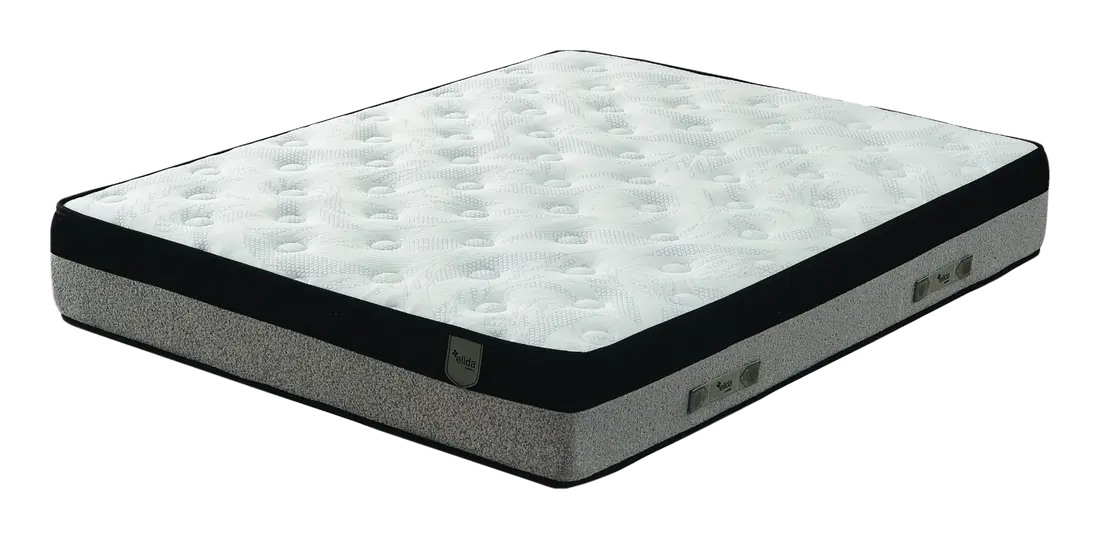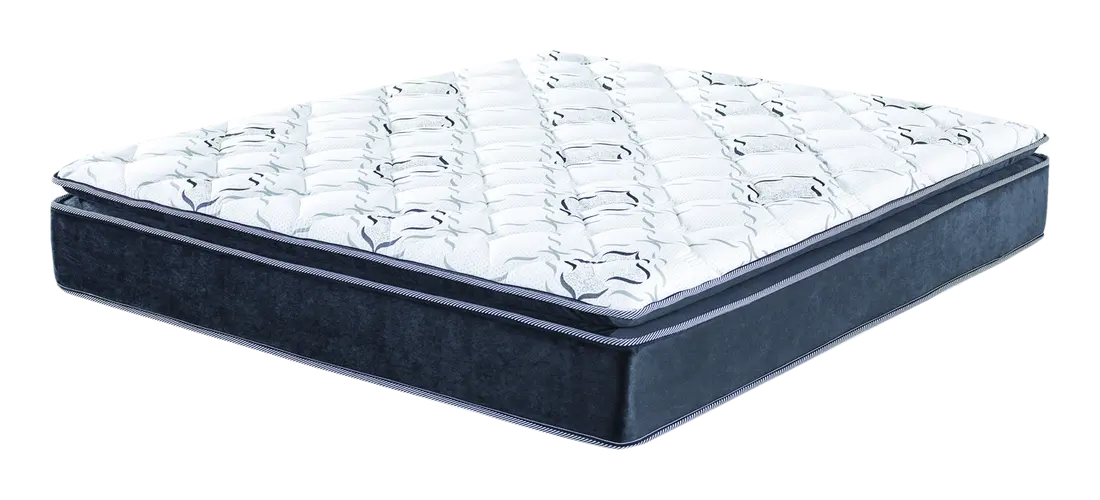
A roll packed mattress is compressed, sealed in film and rolled into a cylinder, so it takes a fraction of the container space of the same mattress shipped flat. A flat packed mattress travels at full size in a bag or carton and arrives ready to put on display. For an importer the choice is a trade between freight cost per piece on one side and construction limits, time in compression and presentation on the other, and it has to be made model by model.
This guide is written by ellda mobilya, a furniture manufacturer in Kayseri, Türkiye, producing sofa sets, corner sofas, bed base sets and mattresses since 2010. Mattresses usually leave our factory in the same container as bed bases and sofas, so the packing method decides how much of that container is left for everything else.
What is a roll packed mattress?
A roll packed mattress is one that has been pressed flat by a machine, vacuum-sealed in plastic film so it cannot expand, then rolled and put in a second film or a carton. Some factories fold the compressed mattress once before rolling it, which gives a shorter, thicker roll. When the film is cut at the destination, the mattress takes in air and returns to its shape.
The method started with foam. The UK's National Bed Federation notes that many foam mattresses are now available to buy rolled-up, also known as bed-in-a-box or mattress-in-a-box. It has since spread to spring mattresses whose construction allows it.
What is a flat packed mattress?
A flat packed mattress is shipped at its full length, width and height. It is sealed in a film bag against moisture and dirt, often with corner protection or a carton, and loaded upright or flat in the container. Nothing inside it is under load during the journey, so there is nothing to recover on arrival.
Some factories offer a middle option: the mattress is compressed and sealed flat, without rolling, and stacked on a pallet. It saves height but not length or width, and it still puts the springs and foam under load for the whole journey.
Which mattress constructions can be roll packed?
Whether a mattress can be rolled is decided by what is inside it, and only the manufacturer can answer for a given model. As a general guide:
| Construction | Roll packing | Why |
|---|---|---|
| Foam core | Common | Foam compresses evenly and has no steel frame |
| Pocket spring | Often possible | Independent springs in fabric pockets can be compressed and bent around a roll, depending on spring height and wire |
| Bonnell or open coil | Usually flat only | The National Bed Federation describes an outer rod strengthening the perimeter; a rigid border frame does not roll |
| Tall pillow-top models | Model by model | Thick comfort layers and quilting may crease or recover unevenly |
| Any model with a rigid edge frame | Flat only | A steel or hard border cannot be bent without damage |
Two points follow for a buyer. First, the packing method is part of the product specification, not a shipping detail to settle later. Second, a range usually ends up mixed: some models rolled, some flat. Our guide to pocket spring vs bonnell explains the two spring units that most often decide this.
How much container space does roll packing save?
Mattresses are volume cargo: a container fills up long before it reaches its weight limit. A 40-foot high cube container has an internal capacity of about 76.3 m³ according to Hapag-Lloyd's container specification, and less than that is usable once packages of different shapes are loaded.
The arithmetic for one mattress is simple. A 160 × 200 cm mattress that is 30 cm high occupies 1.6 × 2.0 × 0.3 = 0.96 m³ before any packaging. That is geometry, not a packed dimension. What the same mattress occupies when rolled depends on the model and the machine, which is why you ask for the packed size both ways.
A hypothetical order shows the effect. Say an importer wants 40 mattresses, and the manufacturer quotes 0.95 m³ per piece packed flat and 0.25 m³ rolled. Both figures are examples for the calculation, not ellda packing data.
| Flat packed | Roll packed | |
|---|---|---|
| Packed volume per mattress (hypothetical) | 0.95 m³ | 0.25 m³ |
| Volume for 40 mattresses | 38 m³ | 10 m³ |
| Share of a 76.3 m³ container | About half | About one eighth |
In this example the rolled mattresses free 28 m³ for bed bases and sofas in the same shipment. Whether that is worth it depends on what else is in the order. Our mixed container guide shows how to plan a load across product groups, and the landed cost guide shows how freight per piece feeds into your selling price.
What are the trade-offs beyond freight?
Freight is the visible saving. The other differences show up later, in the warehouse and the store.
| Point | Roll packed | Flat packed |
|---|---|---|
| Freight volume | Low | High |
| Warehouse space at destination | Low until opened | High from day one |
| Handling | One person can move a roll; rolls are dense and heavy for their size | Bulky; usually two people |
| Condition on arrival | Needs time to recover after opening | Ready for display |
| Time limit | Should be opened within the period the manufacturer states | None from the packing itself |
| Construction choice | Limited to models that can be rolled | Any model |
| Last mile | Fits a car or a parcel network | Needs a van and two-person delivery |
| Customer perception | Familiar from online brands; some customers read it as a budget product | Traditional showroom expectation |
Time in compression is the point most often overlooked on an export order. The clock starts when the mattress is rolled at the factory, not when it reaches the customer. Add the days to the port, the sea transit, customs, your warehouse and the retailer's stock time, then ask the manufacturer in writing how long the model may stay compressed and compare the two.
What can go wrong on a sea route?
Loss of vacuum. A puncture in the film lets air in and the mattress starts to expand inside its pack. A half-expanded roll presses on its neighbours and is difficult to unload. Ask for a second film layer or a carton, and for rolls to be loaded where pallet corners and metal fittings cannot reach them.
Heat and moisture. A closed container heats up by day and cools at night, and condensation forms on the steel. The Transport Information Service of the German insurers explains how this "container rain" develops and why cargo should be loaded dry. For mattresses that means sealed film in both formats, and nothing packed while damp. Our export packing guide covers the moisture measures for a whole furniture load.
Load on flat mattresses. A flat mattress is a soft package. A rigid, heavy package placed on it for several weeks can leave a dent that does not recover. In a mixed container the loading plan should keep bed base bodies on the floor and mattresses on top or along the sides.
Opening at destination. A roll should be cut open carefully so that the cover is not sliced, laid flat, and left to recover before it is judged, sold or stacked. Ask the manufacturer for the recovery time per model and pass it on to your stores.
Roll packed or flat: which suits your business?
- Importer or wholesaler supplying many small stores: roll packed models reduce freight and warehouse space and are easier to redistribute. Check the compression time limit against your stock turn.
- Retailer with a showroom and a delivery team: flat packed display models keep the traditional presentation; rolled models can cover the entry price point and take-away sales.
- Online or parcel-delivered sales: roll packing is close to a requirement, so start the range from the models that can be rolled.
- Project and hospitality orders: many pieces of one model to one address. Rolling saves freight, but allow room and time on site for opening and recovery before the handover date.
- Mixed first order with bed bases and sofas: ask for the loading plan both ways and compare the freight per piece across the whole container, not just the mattress line.
Checklist: what to write in the enquiry
- Models, sizes and quantities
- For each model: can it be roll packed, flat packed or both
- Packed dimensions and gross weight per piece in each format
- Maximum time the model may stay compressed, counted from the packing date
- Recovery time after opening, and opening instructions for your stores
- Outer packing for rolls: second film, carton or bag; for flat: film, corner protection, carton
- Labels on each pack: model, size, packing date, package number, your order number
- Whether bed bases, sofas or corner sofas travel in the same container
- A loading plan with the quote
- Destination port, route and expected transit time, so the compression period can be checked
How ellda mobilya handles mattress packing
Mattresses are one of our four product groups, and they can be combined with sofa sets, corner sofas and bed base sets in one shipment. Export orders are packed for long-distance transport, and a loading plan is shared with the quote.
We do not publish a list of models that can be rolled, packed sizes or pieces per container, because they depend on the model, the size and the rest of the load. Name the models from the mattresses page and your preferred format in the enquiry; the packing method for each line, with its packed dimensions, is confirmed in the quote. If your sales channel needs one format only, say so at the start so the shortlist is built around it. The production steps from order to packing are on our production page.
Next step
List your mattress models and sizes, add the packing questions from the checklist, and send them through our export page. Domestic and regional wholesale buyers can use the wholesale page for the same request.